
19 JAN 2026
Oxfam Hong Kong and NGOs Publish Study Urging Heat‑prevention Systems and Flexible Policies to Protect Workers from Heatstroke
Climate change continues to drive a rise in global average temperatures. Extreme heat put outdoor workers at grave risk, leading to 4 work-related heatstroke fatalities the past year. Oxfam Hong Kong and partner groups (Association for the Rights of Industrial Accident Victims, Hong Kong Catholic Commission for Labour Affairs, Caritas Labour-Friendly Communities Project, and Hong Kong Women Workers’ Association) studied the expanded Oxfam’s Wearable Heat Stroke Detection System and reviewed how the Guidelines on the Prevention of Heatstroke at Work were applied among cleaning workers. The study showed localised heat stress far exceeded official alerts, with hours of warnings issued more than three times as often. It also revealed some contractors neglected to provide rest breaks or protective gear, while some workers were barred from using effective cooling devices such as cooling vests due to rigid rules.
In 2024, Oxfam Hong Kong collaborated with Cyberport health-tech start-up LinkAIQ to launch the Wearable Heat Stroke Detection System, designed to protect cleaning workers from extreme weather risks. The system addresses the shortcomings in existing warnings by delivering timely, both localised and official heat warnings, and monitoring heart rate and skin temperature to reduce health risks. Over the past year, while we are encouraged that some contractors have begun providing smartwatches to workers, the absence of localised alerts limits their effectiveness.
“Oxfam is pioneering solutions to help workers adapt to climate change, from wearable heat‑stroke detection systems to personal cooling equipment. We call on the government to collaborate with businesses to ensure outdoor workers receive the support they need, strengthening their resilience and safeguarding them in extreme heat conditions,” said Dr Leung Ming Fung, Director of the Hong Kong, Macau and Taiwan Programme.
Localised Heat Stress Differs from Labour Department Warnings
During the past summer, Oxfam Hong Kong partnered with multiple NGOs and contractors to install WBGT (Wet Bulb Globe Temperature) monitoring devices across Aberdeen, Kennedy Town, Yau Ma Tei, Tsuen Wan, Kwai Chung, Kwu Tung, Kwun Tong, Sham Shui Po, Yuen Long and Kai Tak. We measured the Hong Kong Heat Index in each location, providing data for outdoor workers. Oxfam also collaborated for the first time with Swire Properties to pilot our Wearable Heat Stroke Detection System at Taikoo Place, enhancing occupational safety awareness among outsourced outdoor workers.
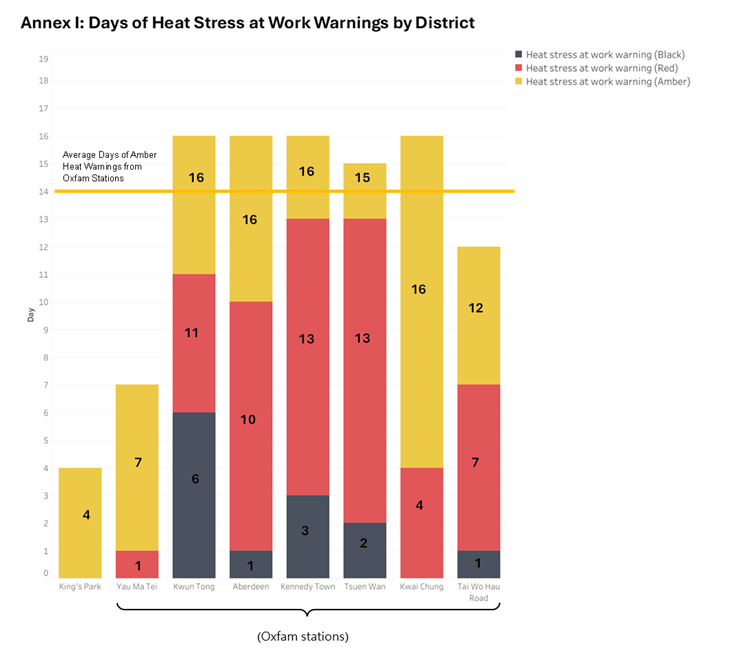
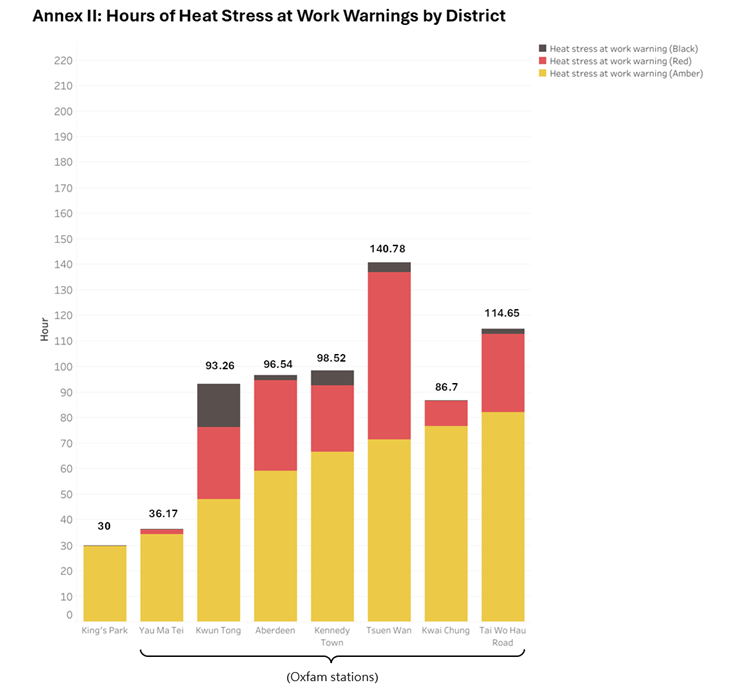
In a 19-day testing period between August and September last year, heat-index data from 7 monitoring stations were collected. Simulating the Labour Department’s warning model, results showed that these stations issued amber warnings on an average of 14 days – 3.5 times more than the official record. The average duration of amber warnings reached 95.23 hours, over three times higher than the Department’s figure. At Tsuen Wan, warnings exceeded the Department’s record by more than 110 hours. While all 7 stations exhibited red or even black warnings, the Department issued only amber warnings (see Annex I and II). Differences were also observed within the same district.
Oxfam Hong Kong distributed around 300 smartwatches to outdoor cleaning and construction workers in 2024 and 2025, letting them to receive both territory-wide and localised heat warnings. Workers reflected the localised warning more accurate, and the watches provided quicker prompts for rest and hydration. With heart rate and skin temperature monitoring, many workers also said that the watches helped prevent heatstroke and hoped the smartwatches would become part of standard protective device.
Inconsistent Cleaning Contractors Implementation of Guidelines
Our partner groups of this study have jointly interviewed 64 outdoor cleaning workers from 6 contractors in the last summer. The interview assessed the heat stroke prevention measures and equipment provided by the contractors. Over 85% of respondents are from two major contractors, covering districts including Yau Tsim Mong, South District, North District, Tsuen Wan, Central and Western, and Kwai Tsing. It is notable that 94% (N=63) reported experiencing at least one early symptom of heat illness while working under extreme heat.
The survey revealed that about 75% (N=63) of workers said their contractors did not adjust working hours during hot weather. Although more than 85% (N=63) could take breaks, and over 90% of them could arrange by themselves, some workers were still denied rest at refuse stations managed by the same contractor.
On personal cooling equipment, 80% (N=60) of workers received anti-heat stress uniforms and sleeves, and nearly 70% (N=63) were given portable fans. However, workers reported that the fans drained the battery quickly, not waterproof, and only distributed once without follow‑up support. Some could not use cooling vests because company rules prohibited covering uniform logos, while others were forced to wear uncomfortable sun hats after being banned from using straw hats.
Calling for a Localised Heat Index and Flexible Worker Policies to Prevent Heat Stroke
The research team recommends the Government install WBGT monitoring devices across all 18 districts, providing outdoor workers with localised heat stress data, thereby enabling appropriate heat prevention measures. In parallel, we suggest that enterprises equip outdoor workers (such as cleaners, construction workers and security guards) with wearable heat stroke detection system, establishing workplace‑based WBGT index and issuing timely warnings to remind workers to take rest breaks. This approach offers a more scientific means of safeguarding occupational safety and health, while also giving employers reliable evidence to support the scheduling of work and rest periods.
In addition, the Government should specify in tender documents that employers are required to make flexible arrangements for rest locations and schedules. Tender clauses should also allow workers to use appropriate heat‑prevention equipment.
Call to Classify Heat Stress as an Occupational Disease
The list of occupational diseases under Hong Kong’s Employees’ Compensation Ordinance has not been updated for over 17 years, this may no longer adequately safeguard workers’ rights. In 2023, the Government responded at the Legislative Council’s Manpower Panel that “heatstroke at work” does not meet the criteria for occupational disease, which require a clear or strong link to the occupation and usually a single cause.
By contrast, as early as 1987, Chinese Mainland classified heatstroke as an occupational disease and subsequently issued diagnostic guidelines. These state that, where a patient has a history of working in high-temperature environments and presents with clinical symptoms such as elevated body temperature, muscle cramps, fainting, low blood pressure, etc., can be diagnosed of occupational heatstroke—provided that supporting examination results of the workplace are taken into account, and other possible causes of similar conditions are excluded. Workers who are formally diagnosed may claim compensation for work related injury from their employer.
In Singapore, employers must send staff for medical care if heat illness symptoms occur at work, inform the doctor of the hot conditions, and obtain a certificate confirming whether the heat illness is job-related. Any confirmed work-related heat illness must be reported to the Ministry of Manpower.
In Japan, when the government issues a “heatstroke alert”, or where the WBGT index in a worker’s environment reaches 28 or above and the worker continues for one hour, employers are responsible for implementing heat prevention measures to protect workers. Otherwise, if employees develop symptoms of heatstroke, the company may face compensation claims.
It is recommended that the Government promotes the installation of heat stress monitoring devices in outdoor workplaces and provides regular medical check ups for workers, to help determine whether heat related illness is induced by work.
Full Report: Wearable Heat Stroke Detection System 2025
- Ends -
About Oxfam Hong Kong
Oxfam is a global organisation committed to creating a world without poverty through its advocacy, development and humanitarian work.
For media enquiries:
Natalie Kei
Acting Communications and Digital Fundraising Manager
Tel: (852) 3120 5257
Email: [email protected]